One deterministic pipeline, 24 real integrations
Every control check that has an API runs as a plain script against your actual infrastructure, with Verazo AI parsing requests and narrating results, never deciding a check's outcome.
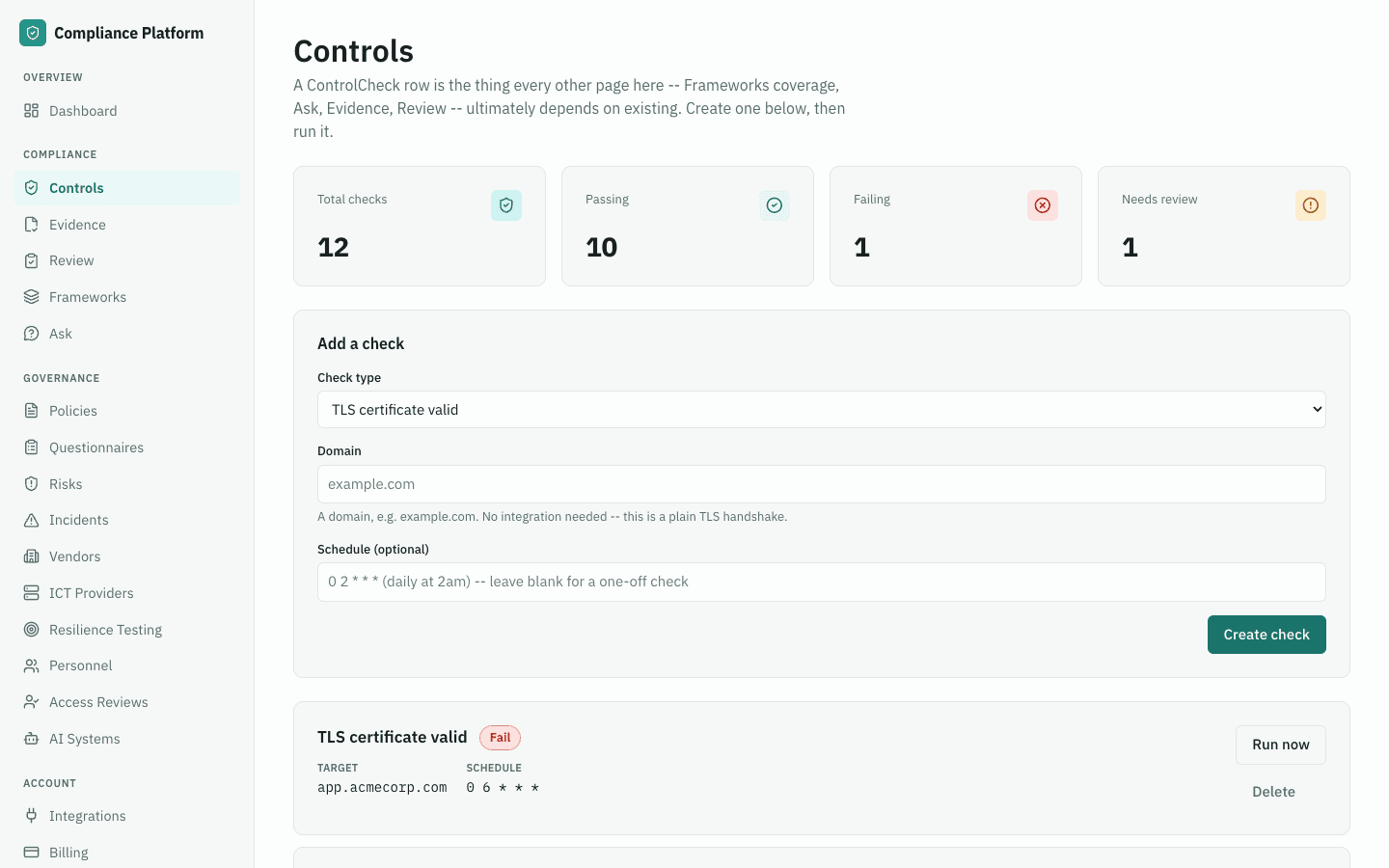
Adding a check takes a target and, where the provider needs one, a stored credential. No check runs without a real API or a real TLS handshake behind it.
24 integrations, seven categories
Every integration below runs at least one real, deterministic check today, reading a setting directly from that provider's own API.
Identity and SSO
- Okta
- Azure AD
- Google Workspace
- Google Cloud Identity
- Auth0
- Duo Security
- OneLogin
- JumpCloud
Cloud infrastructure
- AWS
- Cloudflare
- DigitalOcean
Developer tools
- GitHub
- GitLab
- Bitbucket
- Jira (Atlassian)
Endpoint management
- Jamf
- Microsoft Intune
Observability and IT
- Datadog
- CrowdStrike
- PagerDuty
- ServiceNow
- Zendesk
Data
- Snowflake
Communications
- Slack
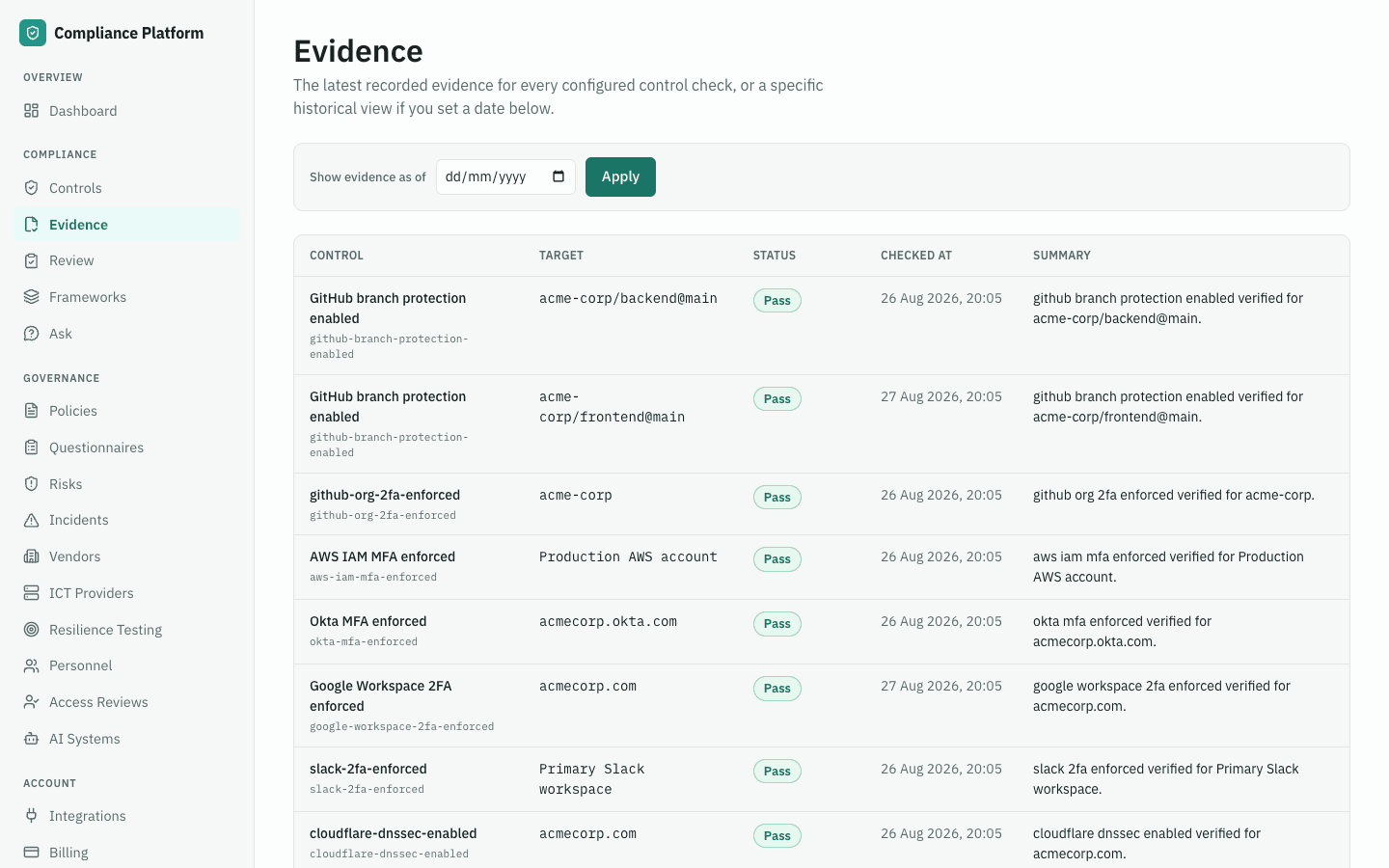
A SOC 2 Type II report samples evidence across an observation window, not a single live snapshot. Set a date here and see exactly what was true then.
An audit trail an auditor can re-derive, not just read
Every evidence record, every approval, and every configuration change writes one entry to a hash-chained audit ledger, signed with HMAC so a tampered entry is detectable, not just discouraged.
Each entry pins the exact control-check version and threshold values in force at the time, so a question asked six months from now about what logic produced a given result has an exact, re-derivable answer, not a best guess from whoever remembers.
A trust center your prospects can visit today
Publish your own compliance posture, certifications, and sub-processor list at a branded page, with a self-serve NDA gate for your more sensitive documents and a human-approval queue for the rest.
- 01Self-declared certifications and sub-processors.
Labeled plainly as self-declared, since no platform can independently audit them.
- 02A real NDA click-through, and a separate approval queue.
Moderately sensitive documents become visible immediately once a visitor accepts your NDA text. Your most sensitive documents wait for a named person to approve each request.
- 03An AI assistant scoped to what you already published.
Verazo AI answers a visitor's question using only your own trust center's published content, never your internal evidence, and every question is logged.
Vendor risk, scored the same way every time
Send a vendor a standard security due-diligence questionnaire by email, and track its response from that vendor's own record, no account required on their side to answer it.
A deterministic 0 to 100 auto-risk score, computed from data sensitivity, self-attested certifications, disclosed sub-processor count, and data-processing-agreement status, sits alongside the risk rating you set by hand. The auto-score is a suggestion. Your rating is what this platform records.
Query your evidence from your own AI assistant, ChatGPT, or your IDE
A read-only MCP server lets you ask about your own control checks, evidence, and risk register in natural language from inside your own AI assistant, ChatGPT, or an editor that supports the protocol, off by default until you turn it on.
Every tool in the server is read-only. No tool can create, update, or delete anything. Each connection is scoped to one organization, authenticated with its own dedicated credential, and every query is logged.
Accessibility checks that follow a real user journey
The accessibility check already reads real WCAG 2.1 A/AA violations from axe-core on your own pages, and two more capabilities take it past a single static scan.
- 01Multi-page flow testing.
An ordered, customer-defined sequence of clicks, typed input, and page navigations walks a full journey, such as signup through checkout, instead of one static page at a time. After each step, the scan re-validates only what changed, using real DOM-mutation tracking rather than re-scanning the whole page from the start. It attributes every violation to the exact step that introduced it.
- 02Visual and semantic mismatch detection.
Some elements respond to a real click or keypress the way a button or link would. That is confirmed by dispatching the event and watching for a real effect, not by trusting an ARIA attribute alone (the markup a screen reader depends on to know what an element is). For each one, the platform captures a screenshot of just that element, and Verazo AI compares how it looks against what the DOM and ARIA declare it as. A styled element that looks interactive but carries no accessible-tree representation is flagged as a mismatch. Verazo AI's visual read is one input alongside the DOM rules and the simulated interaction, never a pass or fail verdict on its own.
iOS and Android accessibility testing for native mobile apps. Coming soon.
A failing check becomes an assigned task, not just an alert
Every check that fails reaches the right person in Slack and email in real time, and a team member turns the fix into an assigned task with a due date.
- 01Slack alerts on every failing check.
A real Slack app, using the organization's own connected bot token, sends a direct message the moment a check fails. It names the control, the target, and the failure summary, with the same alert emailed in parallel. Alerts are on by default for every member who has linked their Slack account, confirmed by an admin.
- 02Remediation tasks that close only when the check does.
One team member assigns another a task tied to a specific failing check, with a due date. It is never assigned to an auditor, since auditors hold no membership in the organization. The task closes only when that check is re-run and passes again. That re-run happens from the dashboard or from the same “Mark complete” button inside the Slack alert, never from a claim alone.
- 03Control exceptions, time-boxed and never a pass in disguise.
An admin or owner documents and time-boxes an accepted risk for a control that cannot currently pass, with a reason on record and an expiry date after which it lapses automatically. It never changes the underlying check's real result to a pass.
Every feature above runs against real infrastructure today, with the same deterministic-first architecture and the same five actions that always stop for a person to confirm them.